Categories of Wine
The whole process of cultivation, production and ageing of wine in Spain is regulated by law “Ley 24/2003“ concerning the vineyards and wine, qualifying wine as natural product produced by fermentation of grapes or must of grapes.
Based on this regulation and according to the EU law, there are 3 categories of origin: D.O.P. (P.D.O.), VdlT and VdM, while the upper category P.D.O. -D.O.P is subdivided in 4 subcategories: V.P., D.O.Ca., D.O., V.C.I.G.
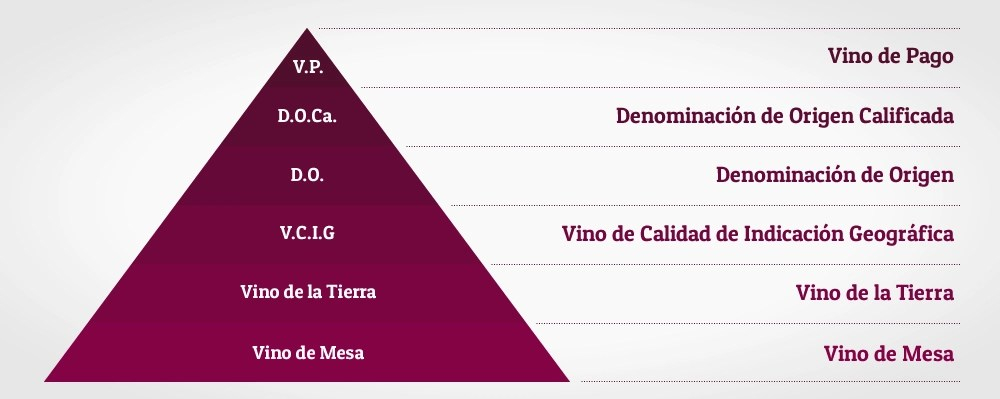
- V.P. (Vino de Pago/Estate Wine) – Peak of the viticulture in Spain. The “Pago” is the expression for unique location of vineyards, mostly small sized, with special climate and soil in compare to the surrounding areas. The proper winery controls the whole process since cultivating and harvesting, fermentation till the final commercialization.
- D.O.Ca. (Denominación de Origen Calificada/Qualified Designation of Origin) – Wine created from grapes of local vineyards reaching high quality during prolonged period. Apart of extra quality control this region might be inscribed on D.O. for at least 10 years before rising up.
- D.O. (Denominación de Origen/Designation of Origin) – Wines produced of grapes from limited areas with higher standard according to the rules of “Consejo Regulador” the special committee creating norms and later checking the process of production. Special supra-national status of D.O. for “Cava” – a Spanish sparkling wine. This status is unifying the production of the whole sparkling wine under the unique D.O.
- V.C. / V.C.I.G. (Vino de Calidad – Indicacion Geografica/Quality Wine) – Wine produced in regions with grapes cultivated on the same place. In generally cannot reach the highest standard of production and control as above.
- VdlT (Vino de la Tierra/Vin de Pays) – Wines produced on limited geographical areas reflecting the special terroir, often reflecting special conditions in final product. At least 85% of grapes might be harvested on the area.
- VdM (Vino de Mesa/Table Wine) – Wines with grapes lacking any trace of origin, made of unclassified grapes and possible free blending.
Age of Wine
The second and important classification of wine in Spain is according to the time the wine was aged in barrels or stainless steel tanks and later in bottles.
The aim is to improve the taste of wine, supporting the evolution of aroma and color while undergoing the chemical reactions. In generally during the aging process the color is changing and flavor become more complex.
In Spain mostly the barrel of 225 liters, French or American oak origin is used to age wine as this volume has a significant influence on the finish.
Recognizing any 5 categories of aged wine: Joven, Roble or Semi-Crianza, Crianza, Reserva and Gran Reserva. The time of aging vary depending on D.O.P. and even the grapes. White wines take shorter time of aging while red varieties can take over 60 months in total.
| D.O.Ca. Rioja (Red) | Barrel | Bottle | Total |
| Joven | none | none | – |
| Roble | not applied | not applied | – |
| Crianza | min 12 | resting | 24 |
| Reserva | min 12 | min 6 | 36 |
| Gran Reserva | min 24 | min 24 | 60 |
| D.O. Ribera (Red) | Barrel | Bottle | Total |
| Joven | max 3 | none | – |
| Roble | min 3 | none | 3 |
| Crianza | min 12 | resting | 24 |
| Reserva | min 12 | resting | 36 |
| Gran Reserva | min 24 | resting | 60 |
As can be seen, these two highly rated wine regions have similar condition applied by P.D.O.
On the other hand white varieties are not created in barrels or bottles such a long time as reds.
| White & Rosé | Barrel | Bottle | Total |
| Joven | none | none | – |
| Crianza | min 6 | resting | 18 |
| Reserva | min 6 | resting | 24 |
| Gran Reserva | min 6 | resting | 48 |
 TRAVELLING SPAIN